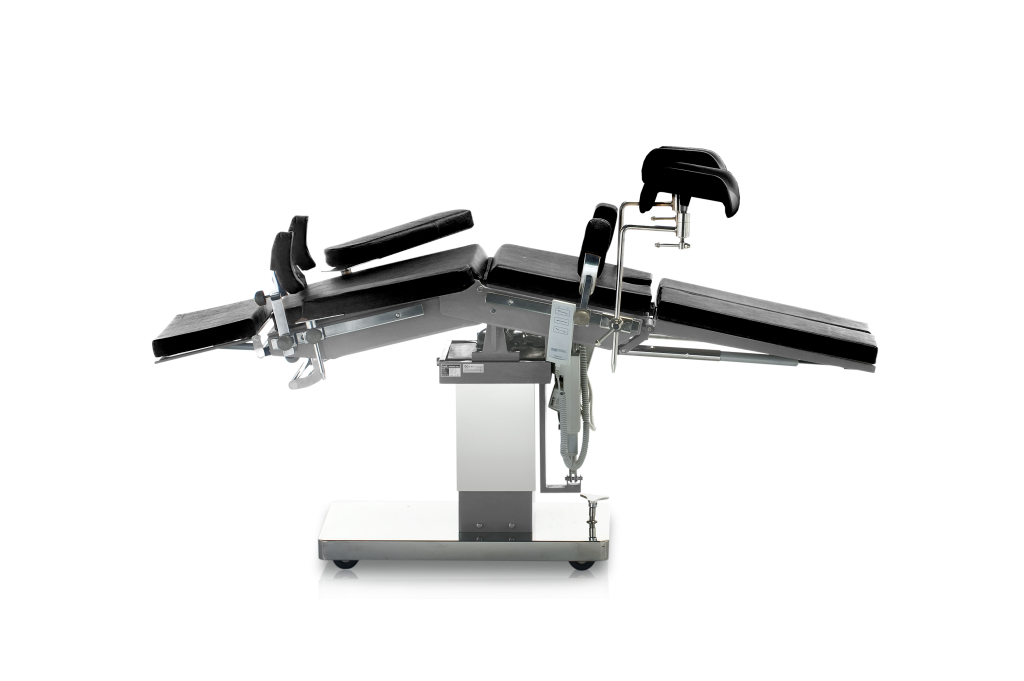
Fracture management is one of the most common and technically demanding aspects of orthopedic surgery. Successful outcomes depend not only on surgical skill and fixation devices but also on the positioning and stability of the patient during the procedure. An Orthopedic operating table, also known as a fracture table, may plays a crucial role in providing optimal exposure, alignment, and access to the surgical site.
The orthopedic table is particularly useful in the treatment of:
- Upper limb fractures
Arm boards and traction devices assist in stabilizing the extremity for Open Reduction and Internal Fixation (ORIF). - Femoral shaft fractures
Traction attachments maintain limb alignment while the surgeon performs internal fixation. - Tibial and ankle fractures
Leg holders and foot traction enable proper reduction and imaging control. - Intertrochanteric and subtrochanteric fractures
Allows easy positioning for dynamic hip screw (DHS) or intramedullary nailing.
Some benefits in Surgical practice, such:
- Improved surgical access: Adjustable positioning allows better exposure of the operative field.
- Enhanced reduction accuracy: Continuous traction and fluoroscopic control improve fracture alignment.
- Patient safety: Stable positioning reduces the risk of pressure injuries and displacement during surgery.
- Intraoperative imaging: Radiolucent features support real time monitoring of fracture reduction and implant placement
- Time efficiency: Facilitates faster setup and smoother intraoperative workflow.
Design and Function
Orthopedic operating tables are specialized surgical platforms designed to accommodate a wide range of orthopedic and trauma procedures. Their design focuses on flexibility, stability, and precision.
There are some features for ortopedic table, include:
- Modular design: allows quick adjustments and attachment of specialized accessories for different body parts (upper limb, lower limb, spine).
- Radiolucent surface: permits intraoperative imaging using C-arm fluoroscopy without obstruction.
- Adjustable sections: Head, back, and leg sections can be independently adjusted for various surgical positions.
- Sturdy base and Locking system: ensures patient stability during forceful manipulations.
- Traction Mechanism: essential for fracture reduction, especially in lower limb fractures such as femoral or tibial shaft fractures.
In modern orthopedic operating tables may integrate with electric and hydraulic controls, remote operation and memory functions. Some advanced models offer:
- Carbon fiber construction for superior radiolucency.
- Automatic traction adjustment for consistent force application.
- 3D imaging compatibility with intraoperative CT or navigation systems.
In conclusion,Orthopedic operating tables are indispensable in fracture surgery, enhancing both surgical precision and patient outcomes. As technology advances, their role continues to expand with improved automation, ergonomics and imaging integration. For any healthcare facility which managing trauma and orthopedic cases, investing in a high quality orthopedic operating table is essential for optimal care delivery. (IW 1310)